From Shoebox Receipts to Sellable Business: Exit Planning Done Right
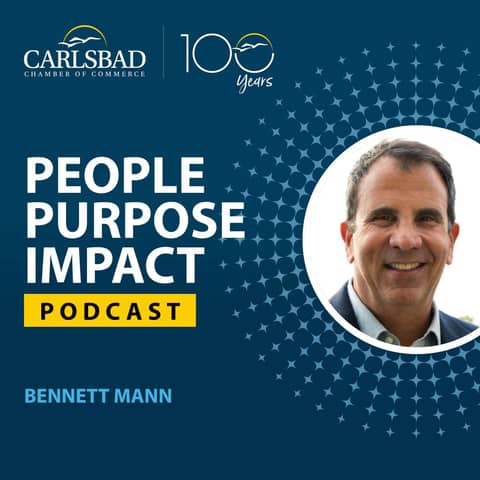


In this episode of Carlsbad: People, Purpose and Impact, host Bret Schanzenbach sits down with Bennett Mann, valuation specialist and business broker with The Chase Group, to talk about what it really takes to build – and successfully sell – a small business.
Bennett, a San Diego native and SDSU economics grad with additional business analysis training from UCSD, shares his career path through valuation roles at Bank of America, CoreLogic, and consulting for Fortune 500 companies. He explains how those experiences led him to focus on privately held small businesses and helping owners plan their “third chapter.”
You’ll hear:
- Why only 15–30% of small businesses that go on the market actually sell
- How to avoid being one of the 70–85% that simply close their doors
- What a valuation specialist does and how Bennett helps owners understand their current market value
- The danger of being an owner-dependent “lifestyle business” vs. building a transferable company
- Why clean, credible financial records are non-negotiable if you want buyers to take you seriously
- How to turn your “secret sauce” into documented intellectual property and processes
- Different types of buyers: family, employees, strategic buyers, and private equity
- Why you should start planning your exit 3–5 years before you want to sell
- Bennett’s love of Carlsbad’s outdoor life, from Batiquitos Lagoon to Lake Calavera
Whether you’re years away from selling or just starting to think about your next chapter, this episode will help you look at your business through a buyer’s eyes and start making decisions that increase both its value and your freedom.
Connect with Bennett Mann
- LinkedIn: Bennett Mann
- Email: bennett@chasegroup.us
Tune in to Carlsbad: People, Purpose and Impact to learn how to build a business that can thrive – and sell – without you.
Quotes
- “Most businesses that don’t sell have one thing in common: the owner is the business.”
- “Clean books are what sell businesses. Buyers have to be able to trust your numbers.”
- “Documenting your ‘secret sauce’ turns what’s in your head into real, transferable value.”
- “Two businesses can have the same bottom line, but the one that runs without the owner is worth far more.”
- “The ideal time to plan your exit is three to five years before you want to sell – or when you start the business.”
Did this episode have a special impact on you? Share how it impacted you
Carlsbad Podcast Social Links:
LinkedIn
Instagram
Facebook
X
YouTube
Sponsor: This show is sponsored and produced by DifMix Productions. To learn more about starting your own podcast, visit www.DifMix.com/podcasting
Host (Bret Schanzenbach):
Carlsbad: People, Purpose and Impact – an essential podcast for those who live, work, visit and play in Carlsbad.
Good morning and welcome, everyone. My name is Bret Schanzenbach. I'm the President and CEO of the Carlsbad Chamber of Commerce. I’m your host today, and I’m excited to have with me Bennett Mann. Bennett is a business broker and valuation specialist with The Chase Group. Good morning, Bennett.
Guest (Bennett Mann):
Good morning, Bret. Great to be here.
Host:
Good to have you today. I was looking at your background and saw that you’re a San Diego native.
Guest:
Indeed. Born and raised.
Host:
Where did you grow up?
Guest:
I grew up very close to San Diego State, and I actually went to San Diego State. So I really didn’t venture too far.
Host:
I saw that – economics major, right?
Guest:
Yes. I’ve always been fascinated by behavior and how people make decisions, and economics ties right into that.
Host:
Go Aztecs! As you and I sit here, we’re just launching into the new basketball season and from what I’ve heard, they have some pretty high hopes.
Guest:
Oh yeah. There was a heartbreaking game against Troy the other day. But definitely high hopes for the season.
Host:
And you stayed very local again. I saw you went to UCSD for business intelligence and analysis.
Guest:
Yes. I went back and earned a certificate from UCSD in business analysis. I’m very curious about technology and wanted to stay current, so that program was very tech-focused.
Host:
Love it. Tell us about your early career. I saw about 15 years consulting for Fortune 500 companies.
Guest:
Right out of college I started working with a builder, which was great, but I quickly realized development is very cyclical. Not long after I joined, people were literally moving their desks as the market shifted.
A friend of mine was working at Bank of America and said, “Why don’t you come here until the market picks up?” So I moved over and worked in their valuation group. That’s where I really learned valuation from soup to nuts – from any type of business to any type of property. It was fantastic training.
I worked for a division within Bank of America that focused on valuation. That division got sold off, and then sold off again. After that I started consulting for those companies and pivoted from pure valuation to helping privately held small businesses – really helping owners think about their "third chapter."
Host:
Nice. I saw Bank of America, then CoreLogic – now rebranded as CATTELL – and some franchise experience with Club Z as well.
Guest:
Yes. My wife works in Encinitas as a school counselor, and she’s been an educator and reading specialist. We ran a learning center together for a while through Club Z. It was a great experience, combining education and small business.
Host:
Very cool. Now, you’ve talked a bit about valuation already. According to LinkedIn you’re a valuation specialist, and you’ve been with The Chase Group for about three years. Tell people what that means. What do you actually do?
Guest:
“Valuation specialist” does sound abstract. Practically speaking, I go into a business, review its operations and financials, and determine what its approximate market value would be.
More importantly, if I can get in early, I can help an owner who has a target number in mind. I can map out how to get from where they are today to the value they want – assuming that goal is realistic.
Host:
I saw a statistic on your website or social media that was a little disconcerting. It said only 15–30% of small businesses that go on the market actually sell. Only 15–30% of the ones trying to sell actually do. Tell us about that.
Guest:
Yeah, it’s a sobering statistic. Privately held businesses are really the backbone of our economy. I’ve seen data showing that a little under 50% of GDP comes from small businesses, and employment from privately held small businesses is around the mid-40% range.
But only a small percentage have a real second act – a true succession plan. Most owners end up simply shutting down and closing the doors when they’re done.
Host:
That’s sad. As you know, because this is your space – and you’re active in our Chamber – people put so much blood, sweat, and tears into their businesses. To hear that most just shut down is tough.
You mentioned earlier that if you start working with owners early enough in that “third chapter” planning – when they hope to sell and move on – you can assist them in reaching a target value.
What are the specific things you help them with? How do you position them so they actually sell and aren’t in that 70–80% whose businesses don’t sell?
Guest:
I’ll start with the simplest point: in most businesses that don’t sell, the owner is the business. If the owner can’t step away, the business doesn’t function.
When I come in, I help them build processes and teams so the business runs – not just the owner. We want the business to be able to go on if they take a vacation or eventually exit.
That means developing processes, training a team, and documenting how things are done. You’re building intellectual property and intangible assets that make the business transferable. It’s not necessarily a huge amount of work, but it does require intentional thinking. And it’s a great exercise for any business owner to create more balance in their life.
Host:
That’s really well said. It’s good practice for any business owner, even just to be able to take a vacation. But really, to have a healthy, thriving business, you need processes and sustainability – and if you ever want something to sell, all of that lives in the same bucket.
My guess is too many people don’t think about these things until the last minute, when they’re suddenly ready to sell.
Guest:
Exactly – or worse, when a life event forces them to sell. They don’t have the time to prepare.
Host:
Like a health crisis?
Guest:
Yes. I’ve had owners come to me after a heart attack or other major event, needing to sell quickly. My heart goes out to them. Small, privately held business owners are the backbone of the economy. They’re essential workers, and they don’t get nearly enough credit for what they do day in and day out.
Host:
Yeah. I was looking at one of your slide decks on LinkedIn about reasons businesses don’t sell. You’ve already touched on one: intellectual property. But another big one you listed was disorganized financial records. Talk about that.
Guest:
A lot of people can relate to clutter – my wife reminds me of that at home. But in business, messy records are a killer. Clean books are what sell businesses.
I’ve had people come in with a shoebox full of receipts. The first thing I ask is, “Have you thought about getting a bookkeeper?” That’s step one.
Clean, credible financial records are crucial. It’s hard to manage what you can’t measure, and buyers need to trust the numbers they’re seeing.
Host:
And from the buyer’s perspective, they want to look at everything – the numbers, the trends, the health of the business. You’ve got to have good, believable financials.
Let’s go back to intellectual property. That’s a different aspect of a business and can be harder for a small owner to wrap their head around. How do you guide someone there? Can you give an example of helping a client get their intellectual property in order for a sale?
Guest:
Intellectual property can sound like a big, scary hurdle, but often it’s simply about documenting what you already do. It’s developing processes and building a team that can carry them out.
For example, when you work with vendors, you probably have a way you like things done. The owner usually has all that institutional memory in their head. I encourage them to bring someone in, show them how it’s done, and then document it.
Once you’ve written it down, you have a process. It might take ten or fifteen minutes after you do a task to sit down and document it, but over time you build a playbook.
And nowadays, you can even use tools like ChatGPT or other large language models to help flesh out and formalize those processes. In the end, you’re really just documenting your “secret sauce” – what makes you special and how you do what you do – so a buyer can see that it’s the company’s system, not just the owner’s magic.
Host:
That makes a lot of sense. You’re helping them document their secret sauce. So when you talk to a potential buyer, you can say, “This doesn’t depend on me. This is how the company does things, and you can carry this on.”
Guest:
Exactly. And when customers call, you want a team that can handle that call – not everything coming to you personally. Otherwise, as we said, you’re never taking a real vacation.
Host:
So true. There were a couple of other reasons in your slide deck about why businesses don’t sell. One was “price gap” – not understanding market value. Talk about that.
Guest:
Everyone has their own idea of what their company is worth, but it’s often not grounded in what a buyer thinks it’s worth.
You can have two equally profitable businesses in the same industry. One is a “lifestyle business” where the owner is the entire operation – they’re there 24/7. The other generates similar cash flow but has a team and processes that allow the owner to step away.
That second business is worth a lot more. As your bottom line improves and your business becomes less dependent on you personally, your value can increase exponentially – not just incrementally.
A one-person operation might only be worth what its revenue stream justifies, if a buyer is even willing to pay for it at all. On the other hand, a company with strong processes, a great team, and real intangible assets can command a much higher multiple, even if the current profits look similar on paper.
Host:
Interesting. I was also intrigued by another part of your slide deck: who you might be selling to. I think a lot of us default to “some third-party buyer,” but you listed several options. Who are some of the different types of buyers?
Guest:
Most people think of a third-party sale, but there are many paths.
A big one is family succession – keeping the business in the family. That can be great, though family dynamics are always important to navigate carefully.
I was working with a roofing company recently. The owner wanted his son to take over the business. The son, however, didn’t want to be a roofer. He wanted to move into HVAC. He was tired of being on top of roofs and wanted a different path.
Other options include selling to employees – which usually involves more outside consultants and planning – or selling to a strategic buyer, like a vendor or someone already in your industry.
And at certain size levels, larger investment groups or private equity firms may be interested in acquiring and packaging your business into their portfolio. There’s really a gamut of possibilities.
Host:
I feel like the buzzword these days – especially for larger businesses – is “private equity, private equity, private equity,” and there are so many subspecialties.
I want to go back to the family side for a minute, because so many businesses start with one person and naturally they want to pass it on. Doing that well, with clearly articulated plans and everyone on the same page, seems key to keeping the family intact as a family.
Guest:
Absolutely. Otherwise, you’re setting yourself up for some very awkward Thanksgiving meals.
Host:
We’re on the brink of Thanksgiving week right now, and I can only imagine how dicey it could get if expectations aren’t clear.
Earlier we were talking about how helpful it is if someone reaches out to you earlier rather than later. How far in advance should somebody be thinking – and not just thinking, but actually reaching out to a professional like you – to curate what will help them sell down the road?
Guest:
In an ideal world, you’d have an exit plan when you start your business. That’s the rare individual.
Realistically, the minimum is about three years, and ideally five years before you’d like to exit. That gives you time to get things in order, develop processes, strengthen your team, and improve your bottom line.
Yes, you want to grow revenue, but you also want to look at your expenses differently and improve profitability. That bottom line is really what buyers focus on.
Host:
So, three to five years – ideally five. If someone listening is thinking, “That’s my timeframe. In three to five years I want to move into my next phase of life,” and they want to chat with you, what’s the best way to reach out?
Guest:
I’m on social media – especially LinkedIn. You can also reach me by email or phone. I love to meet people, have a 30-minute virtual conversation, and see whether I can help. Then we let it organically develop from there.
Host:
Let’s help people find you. On LinkedIn, it’s Bennett Mann – B-E-N-N-E-T-T and M-A-N-N. Lots of double letters in there.
Guest:
Yes, I get that a lot – double T and double N.
Host:
And what’s your email address if someone wants to contact you directly?
Guest:
It’s bennett@chasegroup.us
– all one word: ChaseGroup.us.
Host:
Perfect: bennett@chasegroup.us
.
I also noticed some other things on your profile that interested me. My guess is they relate to your role as a valuator. You’re a licensed real estate broker and a licensed real estate appraiser. Talk about that.
Guest:
Years ago, after working for the builder, I moved fully into the valuation side. I got my broker’s license, which you need in my current capacity for business brokerage, and then I got my appraisal license because I really love valuation.
I’m a big fan of shows like Antiques Roadshow – I geek out on “what gives something its value.” So the appraisal license was a natural fit to deepen my understanding of how value is created.
Host:
That makes sense. Appraiser and valuator go hand-in-hand.
Well, folks, if you know someone – or if you yourself are in that phase of life where you’re thinking about next steps and planning your third chapter – you definitely want to reach out to Bennett and set up that 30-minute consultation.
I know business is so digital these days. You’re based here in our wonderful Carlsbad, California, but I’m guessing you work with people all over.
Guest:
I do. I work with clients across the United States.
Host:
There you go. And that’s the fun thing about podcasts – you never know who’s listening. Someone in Ohio or somewhere else entirely might hear this, and you can help them just as well.
Guest:
Absolutely.
Host:
Back to our wonderful Carlsbad: I saw that in your downtime you’re pretty outdoorsy – surfing and hiking. What are your hobbies?
Guest:
Nothing beats a good hike. I love Batiquitos Lagoon – I’m there with my dog pretty often. I also like hiking up at Lake Calavera – that’s probably my wife’s favorite hike. And of course, spending time at the beach and with family. I love Carlsbad.
Host:
Very nice. Well, thank you so much for coming down and sharing. I feel like people don’t think about the kind of work you do until they desperately need it. It’s great to have you as part of our Chamber family so that when we run across someone who’s thinking about transitioning, we have this valued resource to refer them to.
Guest:
Thank you. And thank you to the Chamber. What you bring to Carlsbad – especially to business owners – is huge. You give them a safe space to break out of that “silo” feeling of running a business and provide so many great resources.
Host:
Thank you. It was a pleasure having you today.
Guest:
Thanks, Bret.
Host:
Thanks for joining us today on our Carlsbad: People, Purpose and Impact podcast. If you got value out of our episode today, please hit the follow button on your favorite podcast app, and please tell a friend. Can’t wait to see you next time on Carlsbad: People, Purpose and Impact.