From Dolphins to Desserts: How Gelato Love Turned Science into Sweetness in Carlsbad
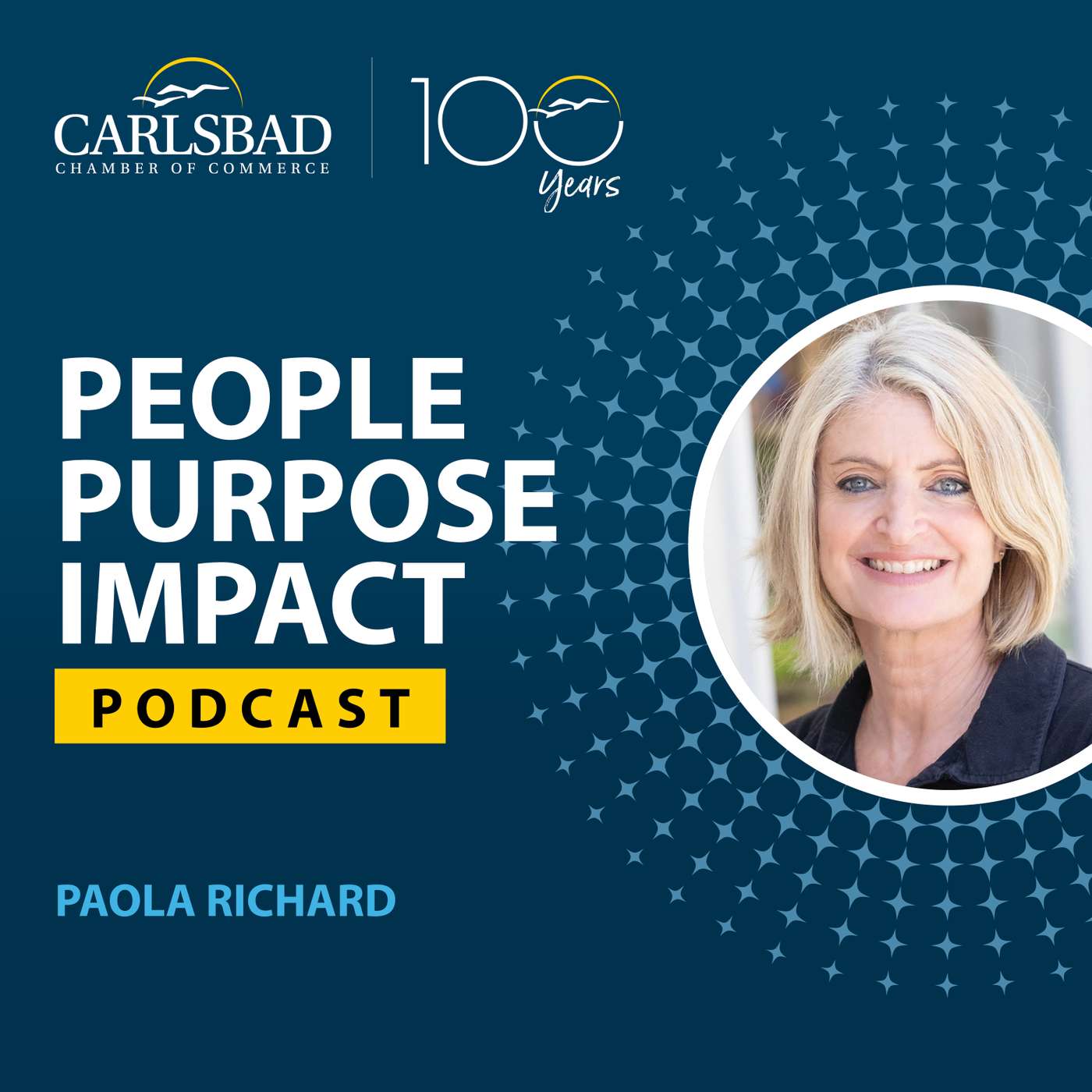






In this episode of “Carlsbad: People, Purpose and Impact,” host Bret Schanzenbach sits down with Paola Richard, CEO and founder of Gelato Love in Carlsbad Village.
Paola shares her global upbringing in Rome with roots across Europe, her early career as a seven-time Italian national synchronized swimming champion training in California, and her transition into marine biology and science journalism, where she wrote and produced content on conservation for outlets like National Geographic Italy and national television.
Seeking a new life adventure, Paola moved back to California, fell in love with Carlsbad, and—thanks to a suggestion from her brother and cousin—made a bold pivot from journalism to entrepreneurship, launching a gelato shop originally called Gaia. With strong support from the Carlsbad Chamber of Commerce, she opened her first store in the Carlsbad Village Faire and eventually rebranded to Gelato Love for clearer, more emotional branding.
Paola explains how she uses her science background to reinvent gelato: experimenting with allulose, a rare sugar that mimics sugar’s taste and texture but doesn’t spike blood sugar, allowing Gelato Love to create no-sugar-added, low-glycemic, clean-label gelato with no artificial stabilizers. They now produce about 5,000 pounds of artisan gelato a day, make custom recipes for clients like Camp Pendleton, and offer 36 flavors in-store out of more than 300 recipes she has developed.
She describes navigating COVID-19 by building an online ordering and local delivery system that literally kept the business alive and brought “little celebrations” to families stuck at home—like the special delivery Bret ordered for his staff. Paola also shares details about her Italian market-style shop, which now includes imported foods, panettone, bags, and accessories from Italy alongside gelato cakes and classic desserts like tiramisu.
Finally, Paola celebrates a huge milestone: being selected by historic Italian company Fabbri to create three specialty flavors (dark chocolate oat milk, lemon cream ginger, and strawberry cheesecake) now available nationwide on Amazon, shipped frozen with dry ice. For Paola, every pint is a “gift of love” from Carlsbad to the rest of the country, and she dreams of further distribution while keeping quality, craft, and “guilt-free celebration” at the center of Gelato Love.
Did this episode have a special impact on you? Share how it impacted you
Carlsbad Podcast Social Links:
LinkedIn
Instagram
Facebook
X
YouTube
Sponsor: This show is sponsored and produced by DifMix Productions. To learn more about starting your own podcast, visit www.DifMix.com/podcasting
Carlsbad: People, Purpose and Impact – Guest: Paola Richard, Gelato Love
Host (Bret Schanzenbach):
Carlsbad: People, Purpose and Impact – an essential podcast for those who live, work, visit and play in Carlsbad.
Good morning and welcome, everyone. My name is Bret Schanzenbach. I'm the President and CEO of the Carlsbad Chamber of Commerce, and I'm once again your host. I’m super excited to have with me today, Paola Richard. Did I say it right this time?
Guest (Paola Richard):
Yes, you did!
Host:
All right, I got it right. She is the CEO and founder of Gelato Love. Good morning, Paola.
Guest:
Good morning. It’s always a pleasure to be with you, Bret, and with the Chamber.
Host:
So good to have you here. I know we’ve talked back and forth for a while about doing this, and we’re finally here. I’m excited.
Guest:
I’m super excited too. This is what I love the most, I have to be honest.
Host:
And I understand why you love it when we get into your background, because you have a really fun background. But before we get to that piece of the puzzle, I love hearing that your hometown is Rome, Italy. Tell us about growing up in Rome.
Guest:
I was born and raised in Rome. My family is actually from all over Italy and Europe. That’s why my last name is French—my grandfather was French. I also have a grandmother from Poland and one from near Austria.
My parents: my father was from near Germany, and my mother was from what was then Yugoslavia, now in the area of former Croatia. So I feel just like an American with different origins. But I was born in Rome and spent most of my life there until I was 18.
I then came to California for a couple of years. I was a synchronized swimmer at the time, training for the Olympics.
Host:
Oh, fun!
Guest:
Yes! But then I went back to Rome. I did my studies there and started my career, but I always had friends in California.
Host:
Oh good, this is going to be fun. Before we get back to the California part though, I saw so many interesting things in your background—a degree in marine biology and something about a dolphin research center?
Guest:
Yes, absolutely. After my swimming career, I stayed in the water. My dream was to save the oceans—save the whales, save the dolphins, and also save the sharks. I love sharks.
My first job, while I was still studying, was probably the best job I’ve ever had. I was hired to swim with dolphins and whales around the world.
Host:
Wow.
Guest:
It was an incredible experience. Sometimes it was scary. I had to jump into the middle of the ocean and just see what was there. It could be dolphins, but it could also be sharks, it could be anything. But it was really some of the best times in my life.
Host:
That is amazing. So this was after you had already been out here for a little bit for synchronized swimming. How did that work out? Did you end up going to the Olympics?
Guest:
So, a sad story—the Italian team was canceled. This was around 1988. I had been national champion for seven years and competed in world championships, but I never went to the Olympics, which is very sad.
But I loved my swimming career, and I felt I really wanted to move on to marine biology and my love for the ocean. I didn’t want to continue another four years to try again.
Host:
Because that’s what it would have taken, another four-year cycle to punch that ticket. Still, quite accomplished.
Guest:
Yes. I came to the United States because at that time the U.S. was the strongest synchronized swimming team in the world. We were waking up at 4 a.m. I was swimming eight to nine hours a day. I did all the work behind it. It was very intense and taught me a lot of discipline.
Host:
Where were you here in California?
Guest:
In the Bay Area—Walnut Creek. The team is still there: the Walnut Creek Aquanuts. Sometimes I go back and celebrate with them yearly. We still have a lot of connections.
The family I used to live with is still like my American family. I had an American “sister,” she’s my age, and she did win the Olympics in 1992—Kristen “Kris” Burkholder (Bob Sprague’s daughter). We’re still best friends. I just attended her daughter’s wedding. She has four kids and married another baseball celebrity, Ed Sprague, who actually won the Olympics in baseball and also the World Series the same year.
Host:
Oh wow. How fun is that! So you had, I think, about two years here in Walnut Creek and then you went back to study. How long were you swimming with the dolphins and sharks?
Guest:
That was quite a few years, until I graduated in marine biology. Then I started a journalism career. I wanted to speak for the researchers and scientists. I became a science writer for organizations, research groups, and universities.
I still had a chance to travel and be in some of the most pristine forests, oceans, and places in the world, and tell stories about people who were trying to save animals and land.
Host:
I saw that you wrote for some very prestigious publications—National Geographic Italy, Huffington Post, others. Tell us about some of those places where you got to publish articles.
Guest:
It was a very lucky career. I became very specialized in my job. There are not a lot of people who go through a full five-year university degree in something like marine biology and then decide to write about it instead of becoming researchers.
So I was in a good position to understand what scientists and researchers were talking about and make it understandable for people, or for kids. I had to write for different media. We all know National Geographic, but I also wrote for documentaries, kids’ documentaries, and TV.
I was on our national TV in Italy for a few years, always talking about conservation. With a friend, we also founded a communication agency specializing in environment and wildlife conservation. That was a lot of fun. I had to learn to write for different audiences and make topics that can be boring or difficult into something engaging.
Host:
Very interesting. How many years were you doing journalism?
Guest:
About 20 years.
Host:
So quite a bit! You had been here in Walnut Creek when you were around 18, but eventually you came back again. What brought you back, and when you came back, was it Southern California or Northern California?
Guest:
Although my career was very interesting and I could have continued, I grew tired of being in Rome. I know it sounds strange, but it’s a big city. There’s a lot of traffic, and I’m just adventurous. I wanted to experience a new way of living and figure out something very different for myself.
California was a natural choice since I still had friends here and kept visiting. At that time, I had a friend who had a vegetarian restaurant in Rome. She moved back to Southern California and asked, “Why don’t you come with me and we can figure out something?”
So we moved to Laguna Niguel in Orange County. I was still working as a correspondent, sending my articles and continuing my journalism career. One day, I drove through Carlsbad, and I fell in love with the place. It was not a business decision. It was just a gut feeling—“Oh my God, this place is amazing. I want to be here.” I had no idea how.
Host:
What year was this approximately?
Guest:
This was around 2012. It took me another couple of years going back and forth and figuring out what I wanted to do. Then it was my brother’s idea to start the business.
He called me and said, “You know, our cousin just quit her corporate job and went to the best gelato school in Italy.” So my brother put us together and said, “You should do that in California.”
I was in shock—me, a business, gelato? I was a journalist, I dealt with the environment. I wasn’t convinced; it took me a few days. But then I thought, “Why not? This is what I wanted—to try something completely different. Can I start with a blank page and test myself in a completely new environment and find solutions?”
It was definitely one of the best decisions of my life, personally. It was so fun.
Host:
I’m always intrigued by the backstory when people start a new business. When you first launched, I think it was under a different name?
Guest:
Yes. It was “Gaia,” which is Mother Earth, the goddess. That was in 2018 when we opened our first store in Carlsbad.
The first step I took once we decided, “Okay, it’s going to be gelato,” was coming here—to the Chamber. Kathy, who still works with you, welcomed me and said, “Yes, I think it’s a great idea. We can definitely help. You should do it.”
So I thought, “Okay, maybe this is the first sign that it could work.” Not only had I never been in business before, but the rules and standards are different in a different continent. I needed help figuring out permits, how to open a business, how to meet people, how to understand the culture.
I honestly wouldn’t be here without the community I found in Carlsbad and the Chamber’s support throughout the years.
Host:
That’s wonderful. When I got here in 2019, I believe it was already Gelato Love. So somewhere between there you changed it?
Guest:
Yes. My cousin Cristina wasn’t feeling as well as I did. She missed Italy and her friends. I bought her out after almost four years and decided to change the name because nobody could remember “Gaia.”
The main question was always people walking into the store and asking, “Hey, are you guys…?” Nobody got the name right. So I thought, okay, I want to expand the concept, change the recipes, work more on our product. Maybe this is a good time to change the name and become Gelato Love, which is what we are now.
Host:
From a pure marketing standpoint, Gelato Love tells you exactly what you get. The other name, I would have been like, “What kind of shop is that?”
You have your location, and for anybody listening who maybe doesn’t know where this place is—maybe you’re not from Carlsbad, and that’s okay, we still love you—it’s down in the heart of the village in the Village Faire center. But you had a second location as well, right?
Guest:
Yes. Around the same time, in late 2018, we had the opportunity to open a bigger production space. From the beginning, people kept insisting we should do more. We were very fortunate—the business was immediately successful. I think there was a need for a gelato place by the beach. We’re just one block away from the ocean, and people loved it.
Because it went so well, investors started coming to me saying, “You should do this, you should do that.” It was very confusing at the time, but we did build a bigger production site.
I started working actively on recipes, drawing on my background as a biologist. I worked with a food scientist from New Zealand who helped me develop a very innovative recipe that we have now.
The second location started out as a production facility with some retail space, but then COVID hit. That was hard and scary for small businesses, especially in food. We had to close the retail portion, but fortunately we survived and used that time to develop our project more.
Host:
That’s your space over here in the business park?
Guest:
Yes.
Host:
I thought you also had a second retail space?
Guest:
We went up to three retail locations. We had a store in downtown San Diego as well, before COVID. When COVID came, I decided to close that one too. It actually helped me clarify which direction I wanted to go.
I wanted to develop the product and go into distribution more than opening multiple locations. I’m open to more stores in the future, but I wanted to first have a solid foundation and deep roots in what we do.
Host:
I’m glad the Carlsbad location is your prime location because it’s one that I frequent a lot. I love it.
Now, you mentioned recipes and your passion for creativity and ingredients. I know that’s been part of our discussions from the beginning. I go out of my way to come to your shop because I know what you do with ingredients. I want my audience to know—talk about the allulose, the low sugar, and all the things you’ve created.
Guest:
First of all, I was never satisfied with something that tastes good but might harm people. Sugar is fine in small quantities, but our sugar intake is way too high.
In frozen desserts like gelato and ice cream, there are also a lot of harsh ingredients used as emulsifiers and stabilizers. My idea was: can we make something that’s not only amazingly good—it has to be good, it’s Italian gelato, I’m representing Italy here—but also good for you? Something that you feel good about even after you’ve had it.
So we started experimenting with all kinds of sugars and ingredients. It was like being in a little chemistry lab. We bought every possible sweetener—from artificial ones to monk fruit and stevia.
We realized artificial sweeteners have many side effects and can interfere with metabolism, the nervous system, and even the heart. So we ruled them out.
We ended up with this rare sugar that is found naturally in some fruits: allulose. It was first used in Korea, so at the beginning we had to import it from Korea. It has an amazing flavor—just like sugar.
Another important detail: sugar in gelato and ice cream is used as an antifreeze to give a creamy texture. Allulose not only replaces sugar but actually gives an even better texture in what we’re doing.
When we discovered that, the “mad scientist” in me was jumping around. At first, it wasn’t approved by the FDA yet, but we were waiting, and right around the time we opened our production facility in 2019, it was approved. Our product can be classified as “no sugar added.” It tastes amazing, and research now shows it also helps metabolize sugar you’ve had previously.
So it acts a bit like a GLP-1—like a natural Ozempic, if I can say that. If you’ve just had a meal with pasta or pizza and then have our gelato at the end, it helps keep your blood sugar level stable.
As a former scientist, I’m super excited about that. We’ve been working with diabetics and using continuous glucose monitors to test it, and we’ve seen that it doesn’t spike blood sugar levels. It can be used safely by everybody.
Now we have sports celebrities, actors, models—anyone interested in high performance and avoiding sugar issues—seeking out our gelato.
Host:
That’s wonderful. So the sugar component is such that it doesn’t spike your blood sugar levels. It’s great for diabetics and pre-diabetics, but really great for anybody.
And your diverse flavors are so fun. You have, what, like 20 flavors at any time?
Guest:
We have 36 flavors in the store at any given time. Over the years I’ve developed more than 300 recipes. I still design new recipes weekly because now we not only make gelato for our store, but we produce gelato for other companies. I make ice cream, sorbets, and new recipes for different needs.
We have versions without sugar, and a high-protein version for Camp Pendleton. The military wanted a high-protein açaí-type dessert, so that’s what we created. In Oceanside there’s a location, Alana Wellness, that serves that exclusively now.
I never thought this could be so fun and creative. It aligns with my personal growth and evolution, which is what I wanted in the first place. I’m still learning so much and I’m very grateful. I couldn’t have done this anywhere else but Carlsbad, to be honest.
Host:
We’re very fortunate you’re here. Before we turned the microphones on, you were sharing some new things coming for your gelato—distribution opportunities that might involve retail channels people are extremely familiar with. By the time people hear this, this will already be live and available, even though today it’s not quite. Tell us what’s going on.
Guest:
For the first time, an artisan product—because we still make everything by hand—is available nationwide. We produce about 5,000 pounds of gelato a day by hand.
We were selected by Fabbri, an iconic Italian company that makes the Amarena Fabbri cherries in syrup that many people know. They’ve been around since 1905 and are in 150 countries. They selected Gelato Love and my recipes—with clean ingredients, no added sugar, and no artificial stabilizers or emulsifiers—to design three flavors for them.
These three flavors are now available on Amazon nationwide. Anyone can go and order them. That’s why I called it Gelato Love—because it’s a gift of love. You can now send a box of six pints of gelato anywhere in the U.S. It’s really my dream that people can enjoy and share this with friends and family across the country.
Host:
That’s amazing. How do you package it? This is a frozen dessert.
Guest:
It took us a long time to develop this project—about two years. First, I created a no-sugar-added gelato line and experimented with Fabbri’s ingredients: their Amarena cherries, ginger, and strawberries.
We developed three flavors:
A dark chocolate that is also dairy-free, made with organic oat milk we make in-house, because I didn’t want to use the chemicals found in most commercial oat milks.
A lemon cream and ginger flavor that uses local lemons from farmers markets in the area—we have so much citrus here.
A strawberry cheesecake flavor.
They’re shipped as a box of six pints. We experimented by building a pallet of boxes and sending it to Chicago, where a fulfillment center that works with Amazon is. Once they get the order, they pack it into a bigger insulated box with dry ice. The dry ice and the box will keep it frozen for three days.
The first time gelato I made with my own hands went to Chicago, then came back to my home in Carlsbad for testing, it was perfect. I cried! I couldn’t believe it. It was so fun and the quality was perfect.
I also adjusted the recipe so it will always be perfect in your freezer. The gelato we serve in the store is kept at a warmer temperature for the display case. If you take that home, it gets really hard in a typical freezer and you have to wait. And nobody wants to wait five minutes.
So we planned the Amazon pints differently. The texture and amount of allulose and other ingredients are balanced so that as soon as you pull it out of your freezer, it’s perfectly scoopable.
Host:
That is so funny—the things you have to think through. So you can get a package of six on Amazon, sent basically anywhere?
Guest:
Anywhere Amazon goes, which is almost anywhere in the U.S. It takes about three days for delivery. It’s amazing. We can send Carlsbad anywhere now.
Host:
I love it. Very fun.
For those who haven’t been to your shop in the village—again, I don’t know who you are, but you need to go—tell us about the other fun items you carry.
Guest:
In the beginning it was just gelato. Then I realized the shop had become like a little piece of Italy in Carlsbad. So I started bringing in everything that I love and use myself.
We have artisan pasta, sauces, artichokes, sun-dried tomatoes—Italian specialty foods. With the holidays approaching, we bring in panettone, the traditional Italian holiday cake.
Then I went further. I started importing bags from Italy made in the same factories that produce for brands like Prada and Bottega Veneta, but at a fraction of the price. They became part of the business, which is fun and a little unexpected. Now when you come in, we have jewelry, bags, other items, as well as cooler bags for gelato.
We also do desserts: I make tiramisu, cakes, and other traditional Italian desserts that I think people should try.
Host:
Speaking of cakes—your gelato cakes. My wife ordered one from your shop for my birthday, which is coming up again if anyone’s listening. It was so fun and so good.
One of the things you’ve shared with me in the past is that Californians, for good reason, are very health-conscious. When we go out for dessert, we feel like we’re cheating. You’ve said, “No, I want guilt-free enjoyment of dessert,” which is what you’ve created.
Guest:
Absolutely.
Host:
And that guilt-free birthday cake was also amazing.
Guest:
Thank you. That reminds me of a study from the University of Pennsylvania. They used the phrase “chocolate cake” in different countries and asked people what came to mind. In the United States, most people responded with the word “guilt.” But in European countries like France or Italy, people said “celebration.”
For me, dessert as an Italian has to be celebration. When I make cakes and I know the person, I think about them while I’m making it. I choose the flavors, colors, and decorations with them in mind.
I’ve been baking and making desserts since I was a kid. I learned from my grandmother. She was amazing. It was always a way to bring joy to family and friends. The gift of dessert is a gift of love—and that’s why the name Gelato Love. That’s the whole philosophy: I want to make something that people can enjoy without feeling guilty, something they can share.
Our store is designed like a classic gelateria you’d find in an Italian piazza. There’s a little seating area, and I invite customers to sit down. Even if you’re just having an espresso, don’t take it to go. It takes only 30 seconds, but be there. Spend some time. Say a few words. Bring a friend. Sit down and have a conversation.
If you go to a restaurant, it can be expensive, and often there’s alcohol involved. But for a gelato, with five or six dollars, you can sit with your family and friends and enjoy your time.
For me, the Amazon project is a big step. We’ve had to expand production—I'm even looking for another space here in Carlsbad, trying to stay in Carlsbad as long as we can. But it’s also about sending this love—Gelato Love—across the country. That philosophy is what drives me. I hope it’s successful. I’m keeping my fingers crossed.
Host:
I have a lot of confidence that it will. If we go back five years to everybody’s least favorite pandemic—when we all had to pivot—you came up with the concept that you still wanted people to have gelato. You were willing to deliver within a certain radius of this area, I believe for free.
As soon as I saw that, I thought, “I want to send this to all my staff members—send them some love from Gelato Love.” I remember doing that, ordering it through you, and you delivered it. It was received extremely well.
Our staff usually does social things together every month, but at that time we couldn’t. It was a great concept, super fun, and everyone appreciated it. I have no doubt that sending your love through Gelato Love all over the country is going to go great.
Guest:
Honestly, Bret, that saved our business during that time. Our store was empty; nobody was around. I knew from Italy that the shutdown was coming—they shut down earlier than the U.S.—so I started working on the website and building an online ordering platform.
My concept was not, “Please support our business, we’re going to be shut down.” It was, “Let us bring you some joy during this time.” Kids were at home, everybody was bored, everything felt dull and anxious.
We had this little van and we were delivering gelato. We could see kids jumping at the windows. It was a little celebration for the day.
Your order from the Chamber, I believe, was one of the first big ones. It showed people this could be done. Throughout COVID, for a couple of years, our delivery system—me, my husband, and one person making gelato—completely saved our business. It was a great adventure.
Host:
I’m very glad it worked and that you survived because, as we all know, some didn’t. We love our Gelato Love.
I know with your journalistic background that at some point we’re going to switch seats and you’re going to interview me.
Guest:
Yes! That’s what I want. I’ve been asking and waiting for that opportunity.
Host:
Now that I’ve got you into my podcast studio, you can see it here. You could do it here and now.
Guest:
I would love that and really enjoy learning more about your background.
Host:
Thank you so much for being part of our Chamber, being part of our community, and for coming and sharing your story today.
Guest:
Of course. It’s been an amazing ten years. We celebrated ten years of Gelato Love last year. For me personally, and hopefully for the community, it’s been a great adventure, and I feel like I’m just beginning.
After Amazon, of course, I want to go into more distribution. But I think receiving your gelato at home is a good way forward. There are a lot of costs in going into grocery stores, and I still want to keep the quality as high as I can.
And you, Bret—yes, I’m curious to learn more about your life. You’re doing so much since you’ve been here. You’re very eclectic and active, and we want to know more!
Host:
Okay, well, you’ll have to do that, and I’m excited. I’ve already thought of three or four different family members around the country that I can send gelato to now. I’m super excited about this new evolution.
We all have those people in our life where you ask, “What do you get them?” They’re at a phase of life where if there’s anything they want or need, they just buy it. So you’re always trying to think of something creative that would be well-received. Hands down, this is a very original idea, and it’s hard to go wrong—who doesn’t like gelato?
Guest:
Exactly. And like you said, it’s always well-received, and it supports this amazing Carlsbad community and small business. The level of innovation we have in Carlsbad—not only in food, but in science, biotech, big companies like Viasat—you’re dealing with so many different worlds here. That’s what makes this place special, and the Chamber special. So thank you for having me. It’s great to share.
Host:
My pleasure. Again, if you haven’t been, please go down to the Carlsbad Village Faire and visit Gelato Love. Get some there. Then go to Amazon, order some, and share the love.
Guest:
Thank you.
Host:
Thanks for joining us today on Carlsbad: People, Purpose and Impact. If you got value out of our episode, please hit the follow button on your favorite podcast app, and please tell a friend. Can’t wait to see you next time on Carlsbad: People, Purpose and Impact.